Four Films about Music: Silent Jazz, Orchestra, Pause
Preview of 'Four Films about Music' (Silent Jazz, Orchestra, Pause, Interior Music). Read our analysis.
Guy Sherwin has spent decades stripping cinema down to its essentials - light, time, and the raw act of observation. His latest work, the 28-minute omnibus Four Films about Music (Silent Jazz / Orchestra / Pause / Interior Music), premieres today, July 26, 2026, and it might be the closest he’s ever come to turning a camera into a musical instrument. Shot largely on a mobile phone, the project is a quiet, restless experiment in listening with your eyes. Sherwin himself describes the process as “the closest I get to improvising,” a musical form he admires but, as a filmmaker, has always found elusive. That tension - between the spontaneous impulse to record and the painstaking craft of shaping those recordings into something coherent - runs through every frame of this four-part suite.
Release Date & Where to Watch
Four Films about Music officially debuts today, July 26, 2026, as part of the EXiS Experimental Film and Video Festival in Seoul. The festival, known for championing boundary-pushing works, is the first and - so far - only venue confirmed for the film. Given Sherwin’s track record, the program is likely to travel to other experimental cinema events in the coming months, but for now, viewers in Seoul have the exclusive chance to catch it. No streaming or home video release has been announced, which feels appropriate: these are films meant to be experienced in a darkened room, where the hum of a mobile-phone camera and the crackle of ambient sound can feel like an intimate conversation.
Cast & Crew
There is no cast to speak of, and that’s very much the point. The sole credited filmmaker is Guy Sherwin, the British avant-garde cinema veteran whose work has long blurred the line between documentary and abstract art. Sherwin serves as director, cinematographer, and editor - and, in the case of Interior Music, a kind of improvised choreographer. As he notes, many of his films “evolve from a single shot, and quite often that shot is an immediate response to a situation unfolding in front of me.” The mobile phone in his pocket becomes a ready-made tool for capturing those moments. No actors, no crew, no elaborate lighting rigs. Just Sherwin, his phone, and whatever the world chooses to present.
Story & What to Expect
Don’t go looking for plot. Four Films about Music is a program of four short pieces, each built around a different relationship between sound, image, and the act of filming. The titles themselves lay out the terrain: Silent Jazz, Orchestra, Pause, and Interior Music.
In Silent Jazz, Sherwin’s camera observes a scene that likely involved live music, but the resulting film is wordless, almost meditative. The “silent jazz” isn’t a contradiction - it’s a visual rhythm, a way of letting movement and light suggest the syncopation that sound would provide. Orchestra follows a similar logic, though here Sherwin seems to be hunting for musicality in the everyday: a street performer, a cluster of pedestrians, the accidental symphony of city life. Both films were shot “using the convenience of the mobile phone in my pocket,” as Sherwin puts it, and both rely on the filmmaker’s instinctive decision to press record in the moment.
The third piece, Pause, is something else. Sherwin admits it “clearly involved some planning,” but even here the process was anything but linear. “After the initial recording, I had to work with the fragments of sound and image to see where they might lead, in a lengthy process of trial and error.” The result is a film that feels constructed from silence and sudden bursts - a deliberate disruption of the flow that the first two pieces establish. It’s the most formally adventurous of the four, a reminder that Sherwin’s improvisation never sacrifices precision.
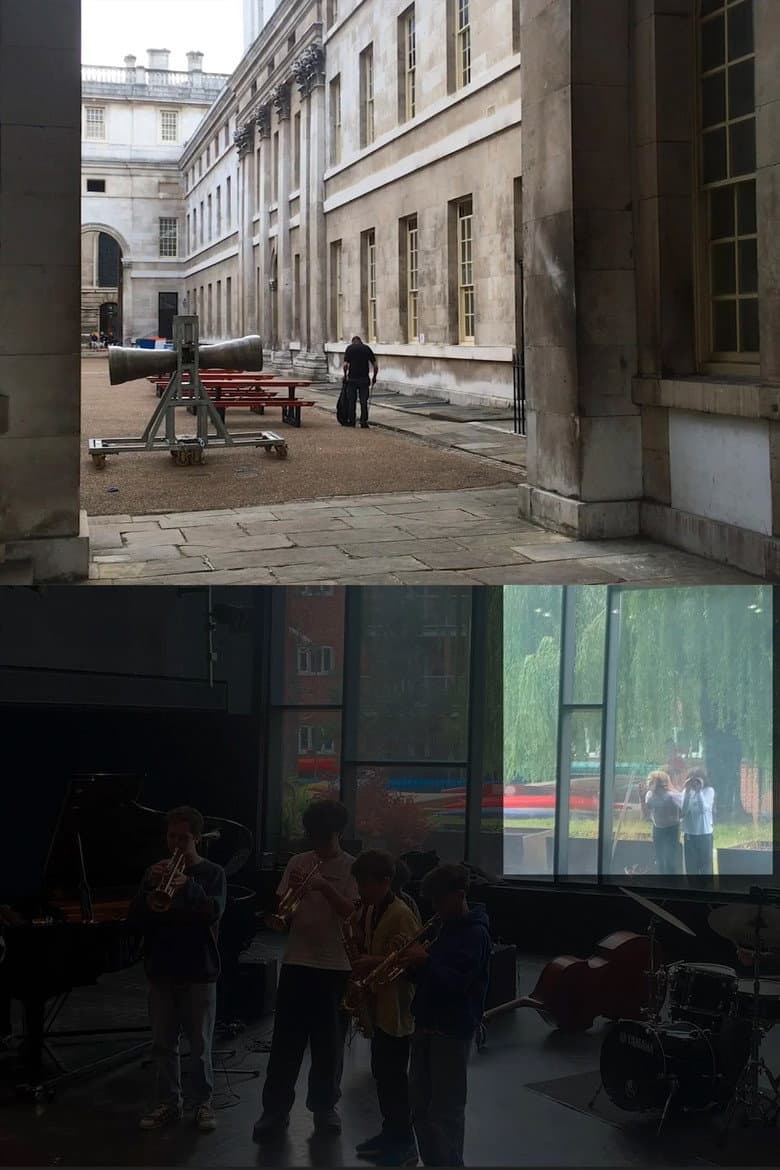
Then comes Interior Music, the program’s most direct synthesis of image and sound. Sherwin filmed inside the Trinity Conservatoire in Greenwich, using the camera “in direct response to music emanating” from the building. He doesn’t just record a performance; he lets the music guide where he points the lens, how long he holds a shot, when he cuts away. The film becomes a kind of visual translation - a way of seeing sound. The conservatoire’s architecture, the movement of musicians, the play of light through windows - all of it is orchestrated by the melodies pouring out of unseen instrumentalists.
Across the 28-minute runtime, the four films don’t so much tell a story as they invite the viewer into a process. Sherwin is transparent about his method: “I often sense immediately that something might be made from the situation I find myself in, but only after studying the shots on my computer do I discover the direction they might take.” That back-and-forth between impulse and reflection is the heart of the program. We’re not watching finished statements; we’re watching sentences being written in real time.
Why It’s Worth Watching
In an era of blockbuster budgets and hyper-polished streaming content, Sherwin’s Four Films about Music is a defiantly small-scale, handmade object. It’s worth seeing for its sheer formal honesty - a filmmaker using the cheapest tool available and turning it into an instrument of serious inquiry. The mobile phone isn’t a gimmick here; it’s a necessity. It allows Sherwin to operate with the lightness of a photographer, trusting that the right moment will appear if he’s patient enough.
The program also offers a rare glimpse into how experimental cinema actually works. Most audiences only see the finished film, the final cut. Sherwin lets us peek behind the curtain: the trial and error, the fragments that didn’t quite fit, the slow discovery of meaning in a pile of raw footage. For anyone interested in the intersection of music and moving image - or, more broadly, in how artists think on their feet - this is a masterclass disguised as a short-film collection.
And there’s something quietly moving about the humility of the project. Sherwin doesn’t claim to be a musician. He admits that improvisation is “difficult to attain as a filmmaker.” But in Four Films about Music, he comes as close as any director could, not by mimicking jazz or orchestral structure, but by letting the camera listen. That’s the kind of cinema that doesn’t just entertain - it teaches you how to see. And in a summer packed with sequels and explosions, that silent, searching quality feels like a gift.