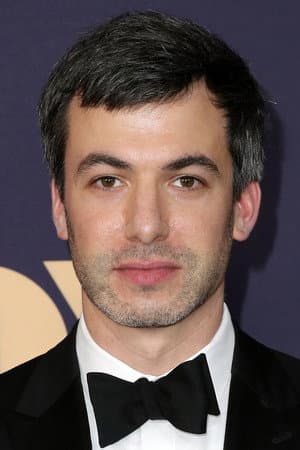
Nathan Fielder has spent his career turning awkwardness into an art form, but his latest project takes that instinct somewhere far stranger. The full trailer for his Elizabeth Holmes documentary has arrived, and it confirms what early teases only hinted at: this is not the straightforward true-crime retread audiences have come to expect from the disgraced Theranos founder's saga. The roughly two-minute preview lays out a film that appears to blend archival material, Fielder's signature deadpan staging, and a genuine curiosity about how belief and self-deception operate inside the machinery of Silicon Valley hype.
The trailer opens on familiar ground for anyone who followed the story over the past decade, then quickly veers into territory that feels distinctly Fielder. Interviewees speak in flat, matter-of-fact tones. Pauses stretch just a beat too long. A voice-over that sounds like it belongs to a corporate training video collides with footage of earnest young engineers describing a mission they believed in. The cumulative effect is less gotcha journalism than an extended meditation on how charismatic conviction functions as a kind of performance, and what happens when the audience finally stops applauding.
A Documentarian Who Prefers Unease to Easy Answers
Fielder built his reputation with projects that weaponize social discomfort, most notably "Nathan for You," in which he offered absurd business advice to real small-business owners, and more recently "The Rehearsal," a series that dissolved the line between preparation and lived experience. Both drew audiences willing to sit with cringe long enough for something more unsettling to surface.
That résumé matters here. A conventional documentary about Holmes would likely march chronologically through the rise and fall of Theranos, punctuated by talking heads and courtroom updates. The trailer suggests Fielder is after something less tidy. By declining to tell viewers how to feel, the film appears to ask why so many intelligent people wanted to believe, and whether the same forces are still operating in the broader startup ecosystem.
The Story That Refuses to Stay in the Past
Holmes herself remains one of the most parsed figures in recent business history. She founded Theranos as a young entrepreneur promising to revolutionize blood testing with technology that could run hundreds of diagnostics from a single finger-stick sample. The company attracted a star-studded board, major investors, and a valuation that made Holmes a billionaire on paper before reporting revealed that the technology did not work as advertised. She was later convicted on fraud charges, a fall documented in books, podcasts, and a scripted miniseries.
Fielder's contribution seems less interested in relitigating guilt than in examining the cultural appetite that fed the myth. The trailer includes glimpses of the pitch-deck language, the TED-style confidence, and the reverence that once surrounded Holmes - elements that feel uncomfortably current even now. If the film has a thesis, the preview suggests it may be this: the conditions that produced Theranos have not gone away. They have simply been rebranded for the next round of funding.
What the Trailer Leaves Unsaid
Notably absent from the preview is any heavy-handed moralizing. There are no triumphant music swells, no dramatic sting when a former employee contradicts the official narrative. Instead, the trailer trusts its audience to recognize the absurdity on its own, which is both the promise and the risk of Fielder's approach. Viewers who want a clean villain story may leave frustrated. Viewers willing to laugh uncomfortably before the unease settles in will likely find plenty to chew on.
The film also appears to widen its lens beyond Holmes as an individual, gesturing toward the investors, journalists, and institutions that amplified the story before the cracks became impossible to ignore. That broader focus could distinguish it from earlier treatments. Fielder's method has always been less about catching people in lies than about creating conditions in which they reveal themselves, and applying that method to a subject this well-documented is a genuine gamble.
Why It Lands Now
The timing is not incidental. Trust in technology companies and their founders has eroded unevenly over the past several years, with each new scandal inviting comparisons to Theranos. A documentary that treats the episode as a case study in collective belief rather than a single woman's deception may resonate differently than the coverage that preceded it. It also arrives at a moment when audiences seem increasingly drawn to stories about systems rather than singular villains.
For now, the trailer does its job: it makes the case that there is more to say about Elizabeth Holmes, and that Nathan Fielder might be an unexpectedly apt person to say it. Whether the finished film delivers on that promise will be settled when it reaches viewers. But the preview alone has accomplished something difficult, generating genuine curiosity about a story most people assumed they already knew.
Nathan Fielder's Elizabeth Holmes documentary is coming soon.
Source: The Hollywood Reporter