Twenty-five years after the September 11 attacks, Hollywood's relationship with that day remains one of the most scrutinized and uneasy partnerships in modern filmmaking. Few events in American history have been processed so quickly on screen, and fewer still have provoked such sustained debate about whether cinema should process them at all.
The attacks killed nearly 3,000 people and reshaped the country's politics, security apparatus, and cultural instincts almost overnight. Studios responded with a mixture of caution and improvisation: delaying releases deemed insensitive, scrubbing shots of the World Trade Center from finished films, and quietly re-editing trailers that had once treated the towers as shorthand for New York glamour. What followed over the next two decades was not a single reckoning but a series of them, each filtered through the anxieties of its moment.
A Reluctant First Wave
The earliest responses arrived with unusual speed, arriving in theaters within eighteen months of the attacks even as industry leaders insisted it was too soon. Spike Lee's "25th Hour," released in 2002, was among the first major studio films to address the attacks directly, using a Manhattan still dusted with grief as the backdrop for a convicted drug dealer's final day of freedom. The film's most discussed sequence - a furious monologue cataloging the city's many tribes and grudges - became an early template for how American cinema might channel post-9/11 anger without naming its source outright.
That same year, "The Guys" adapted a stage play about a fire captain drafting eulogies for fallen firefighters, while "United 93" director Paul Greengrass would spend several more years preparing his own account of the flight that crashed in a Pennsylvania field. The delay was deliberate, and it set a pattern: filmmakers were willing to engage, but not on the schedule the news cycle demanded.
Two Paul Greengrass Films, Two Approaches
When "United 93" finally arrived in 2006, it drew praise for its documentary-like restraint and criticism for what some families called an unbearable act of reenactment. Greengrass cast unknown actors and avoided recognizable stars, a choice that pushed audiences toward the ordinary passengers rather than the spectacle.
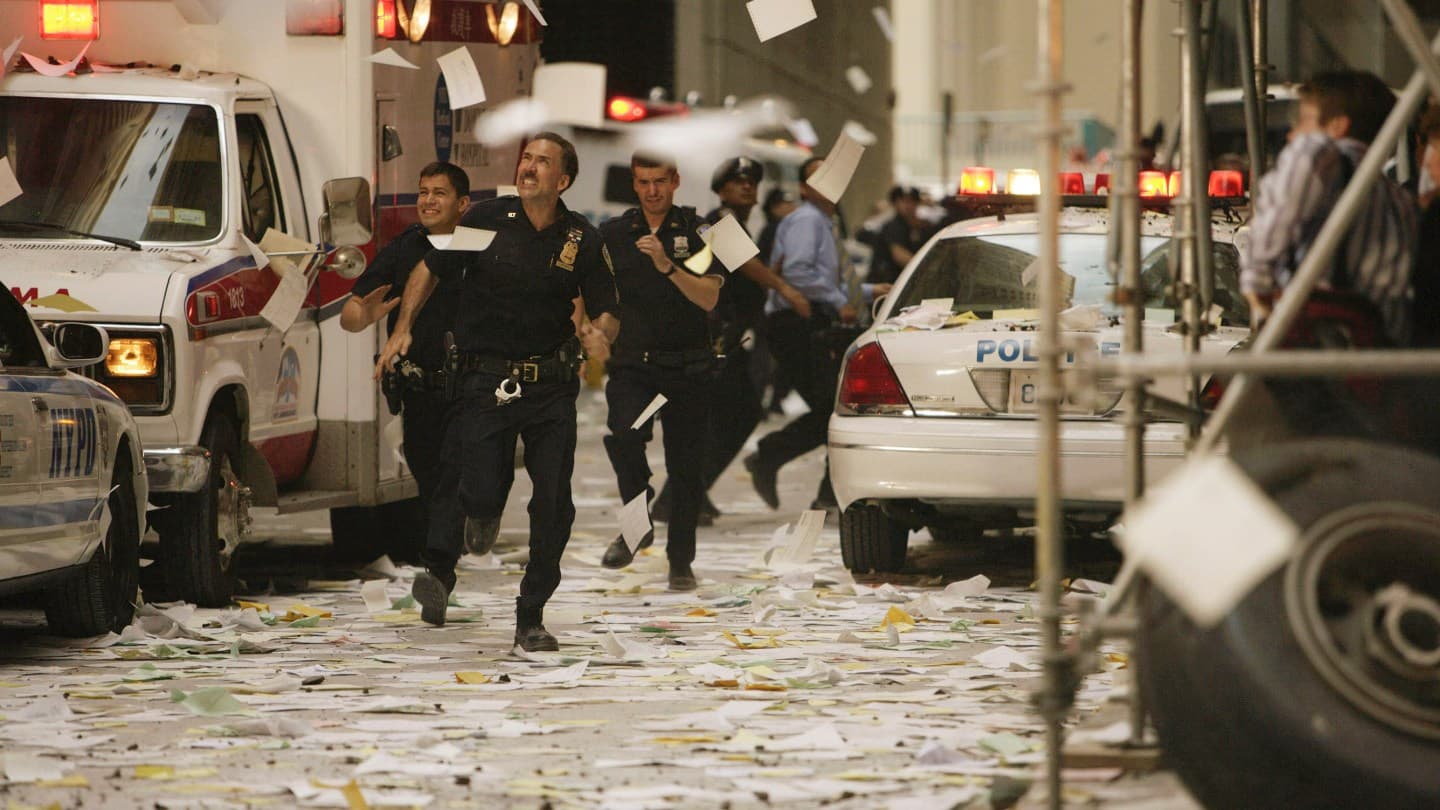
Oliver Stone took the opposite tack that same year with "World Trade Center," a rescue drama centered on two Port Authority police officers trapped in the rubble. Stone, whose earlier films had made him a symbol of countercultural provocation, delivered something closer to a traditional American survival story. Neither film became the definitive statement observers had anticipated. Together, though, they demonstrated the range of permissible approaches: the procedural and the personal, the ensemble and the intimate.
The War at a Distance
As the wars in Afghanistan and Iraq stretched on, Hollywood's attention drifted from the attacks themselves to their consequences. Kathryn Bigelow's "The Hurt Locker" and "Zero Dark Thirty" examined the machinery of the post-9/11 military and intelligence apparatus, the latter drawing fierce argument over its depiction of interrogation. "Zero Dark Thirty" also became a flashpoint in Washington, with lawmakers demanding answers about whether classified material had informed its script.
These films treated September 11 less as a subject than as an origin point - the event that set everything else in motion. That shift mirrored a broader cultural move, as the day itself receded from daily conversation even as its policy legacy hardened.
The Outsider's View and the Problem of Taste
Not every entry came from an American perspective. "United 93" was a British production, and its outsider's eye may help explain its cool reception among some American audiences. Meanwhile, films that used the attacks as texture rather than subject drew accusations of exploitation. "Remember Me," a 2010 romance, provoked anger for a closing twist that revealed its protagonist inside the towers on the morning of the attacks. The backlash illustrated an unwritten rule that has never fully relaxed: the day may be referenced, but it must not be used for surprise.
What Hollywood Learned, and What It Didn't
Two and a half decades on, the most durable 9/11 films tend to be the ones that avoid grand pronouncements. They work at the scale of a single apartment, a single cockpit, a single surviving officer. The industry never produced the sweeping, unifying epic that some commentators predicted in the fall of 2001 - perhaps because no such film was possible, or perhaps because audiences never wanted one.
What remains is a small, contested canon that continues to be argued over, taught, and occasionally reopened. Each new anniversary brings fresh assessments, and each assessment seems to reach the same tentative conclusion: Hollywood has not resolved September 11, and there is no sign it ever will.
Source: The Hollywood Reporter