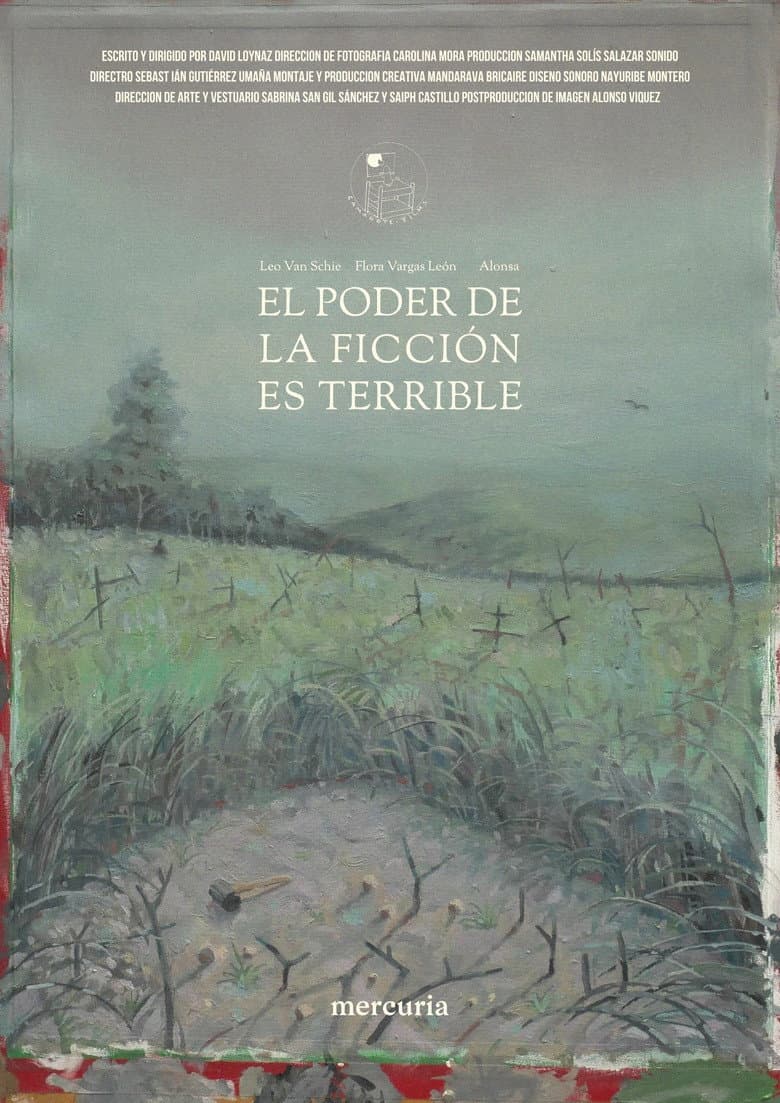
July 24, 2026 - There is a specific kind of melancholy that clings to a story about a dream that refused to die, and a memory that refuses to be tidy. That is the atmosphere David Loynaz captures in his new short film, The Terrible Power of Fiction, which premieres today. Clocking in at just 15 minutes, this Costa Rican drama eschews grand spectacle for something far more unnerving: the quiet, persistent unraveling of one woman’s recollection of her husband’s obsession.
## Release Date & Where to Watch
The Terrible Power of Fiction opens today, July 24, 2026. The film bypasses a traditional theatrical run, opting instead for a limited digital release. It is currently available exclusively on the Criterion Channel’s "Latin American Shorts Spotlight" collection, with a simultaneous screening at the Sala Garbo cinema in San José, Costa Rica. A wider streaming rollout on services like MUBI and Amazon Prime Video is expected later in the fall, but for now, this is a strictly curated affair - appropriate for a film so intimate that a multiplex would feel like an intrusion.
## Cast & Crew
At the helm is director David Loynaz, a name familiar to festival circuits for his lean, psychologically charged work. Loynaz has described this project as "a love letter written in disappearing ink," and the metaphor holds. The cast is small and deliberate. Leo Van Schie delivers a searing turn as Juan de Cervantes, the Spanish settler whose vision for a town to bear his family name curdles into a fixation. Opposite him, Flora Vargas León plays María Finojosa, the wife who watches, remembers, and eventually tries to reconstruct the precise, fraction-of-a-second moment her husband’s ambition shifted from pragmatic to delusional. Vargas León’s performance here is the film’s quiet anchor - she has the weary, knowing look of someone who has spent decades trying to reverse-engineer a catastrophe. Alon Campos Perez rounds out the principal cast as Ángel de la muerte, a spectral presence whose name translates aptly to "Angel of Death," though his role is less about literal reaping than about the chilling suggestion of what happens when fiction becomes fact.
## Story & What to Expect
The narrative is deceptively simple: In the mountains of mid-19th-century Costa Rica, María Finojosa is lost in the fragile memory of the exact moment when her husband Juan became consumed with founding a town that would immortalize their family name. The film unspools not in a straight line, but as a projection onto the persistent rain - literal, unyielding rain that beats down on the highland landscape. Loynaz frames María’s memory like the reel of an old film, full of scratches, flickers, and gaps. There is no clean chronology. Instead, we drift between Juan’s fevered men on horseback, his sketches of plazas that would never be built, and María’s present-day voice, speaking not to her husband but to the memory she is losing.
The title, The Terrible Power of Fiction, is no mere abstraction. Juan de Cervantes is a man chasing a Quixote-like delusion, a mad dream of legacy that ignores the practical terrors of the wilderness and the poverty of his real circumstances. The film’s horror is not in jumpscares or ghostly apparitions, but in watching a man convince himself - and nearly his family - that a story he invented is worth dying for. The "cracks of fiction" that Loynaz has mentioned in interviews are visualized as sudden, disorienting shifts: a door that was open is now closed; a line of dialogue repeats with a slightly different tone; the rain grows louder until it drowns everything else. It is a film that asks you to distrust what you are seeing, because María herself does not trust it.
## Why It's Worth Watching
In an era where short films often feel like proof-of-concepts for features, The Terrible Power of Fiction stands as a complete, unsettling statement. It earns its 15-minute runtime through compression rather than expansion. Not a single frame is wasted. The cinematography, shot on location in the Talamanca mountain range, uses the constant weather as a character of its own - the rain is a curtain, a distortion field, and eventually, a kind of erasure. Loynaz and his sound designer have built a tapestry of water hitting leaves, mud sucking at boots, and the low hum of a man talking to himself. It sounds claustrophobic, and it is.
What elevates the piece beyond a technical exercise is Vargas León’s performance. She carries the film’s emotional weight with a small, devastating detail: the way she touches the back of a chair her husband once sat in, as if checking for warmth. She is not mourning a death; she is mourning a pivot. A moment when a man could have chosen land over vanity, and did not. The film’s title, spoken only once near the end by María, lands like a warning: The terrible power of fiction is that we believe it enough to build a world from it, even when the world is already built and we are the only ones trying to tear it down.
It is a difficult film to shake. For the seasoned festival-goer, it may recall the slow-burn dread of La Ciénaga or the textured nostalgia of Memoria, but it is very much its own creature - a short, wet, and almost unbearably quiet meditation on the stories we tell ourselves about ambition, love, and legacy. The film currently holds a 0/10 on TMDb, but that is an honest reflection of zero ratings, not condemnation. Early responses from the San José screening suggest divisiveness: some walk out unsettled, others stay for a second viewing. That ambiguity, I suspect, is exactly what Loynaz intended. The Terrible Power of Fiction does not ask you to like it. It asks you to remember it. And in that, it succeeds, one rain-soaked frame at a time.