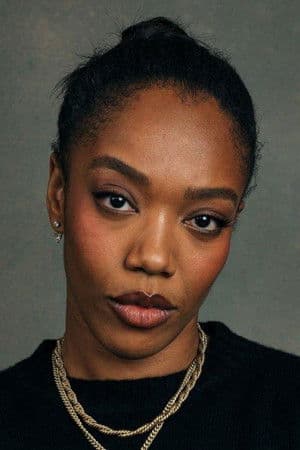
Naomi Ackie has never been one to chase the noise. So when the British actress sat down for a wide-ranging conversation this week, it made a certain kind of sense that the talk would drift toward the machinery of fame, the strange gravity of a galaxy far, far away, and the practical matter of a hand-cranked radio. The through-line, as Ackie tells it, is preparedness - for the industry, for the unexpected, and for whatever comes after the lights go down.
Ackie, who broke through to global audiences with her portrayal of Whitney Houston in the 2022 biopic "I Wanna Dance with Somebody," has spent the past several years navigating a career that swung from intimate character work to one of the largest franchises on the planet. That whiplash is part of what she describes as the "Hollywood machine" - a phrase she uses not with bitterness but with the clear-eyed detachment of someone who has learned to see the gears turning.
The View From Inside the Machine
In Ackie's telling, the machine is less a single villain than an ecosystem: the casting cycles, the press circuits, the expectation that an actor's private life becomes public currency. She has spoken before about the disorientation of sudden visibility, and she returns to that theme here, framing it as something an actor has to actively manage rather than simply endure.
Her approach is unglamorous by design. Ackie has said she leans on a tight circle of trusted collaborators and on the discipline of the craft itself - the reading, the rehearsal, the slow build of a character - as an anchor when the surrounding apparatus gets loud. The work, in other words, is the antidote to the hype.
That perspective likely shaped how she processed her time in the "Star Wars" universe, where she played Jannah in 2019's "The Rise of Skywalker." For an actor raised on the original trilogy, stepping into that world was surreal in the literal sense - a collision of childhood imagination and industrial-scale production. Ackie has described the experience as both thrilling and disorienting, a reminder that even the most mythic storytelling is, behind the scenes, a job with call sheets and catering and a lot of waiting around in costume.
A Galaxy of Logistics
What seems to have stayed with her is not the scale but the people. Large franchise sets are their own small towns, and Ackie has talked about the camaraderie that forms in the margins - the crew members, the stunt teams, the fellow actors killing time between setups. The myth is on screen; the reality is a bunch of professionals trying to get a shot before the light changes.
She has also been candid that franchise work, however exhilarating, is not the whole of what she wants to do. Her filmography since "Star Wars" has skewed toward smaller, thornier projects, and she has spoken about the importance of variety for an actor's long-term health. The machine can make you famous; it cannot, on its own, make you interesting. That part is on you.
Why a Crank Radio?
Then there is the crank radio - the detail that has understandably drawn curiosity. Ackie's interest in one is not, as far as she has explained it, a signal of imminent doom or a pivot to survivalist content. It is closer to a habit of mind: a preference for things that work without permission, that do not depend on a grid, a signal, or a subscription.
It is also, in a small way, a statement about autonomy. In an industry where so much is contingent - on casting directors, on algorithms, on the mood of a studio - owning a device that functions entirely on your own effort has a certain appeal. Turn the handle, get the news. No intermediary required.
Ackie's career has been marked by that same instinct: choose the part that scares you, keep your footing, do not let the machine decide what you are. Whether she is playing an icon, a resistance fighter, or simply someone planning for a power outage, the method holds.
She has not announced her next project, and she does not appear to be in any hurry to. For an actor who has already been inside two of the biggest pop-culture engines of the past decade, the quieter move - the crank radio, the closed circle, the next script worth saying yes to - may be the most deliberate one yet.
Source: The Hollywood Reporter