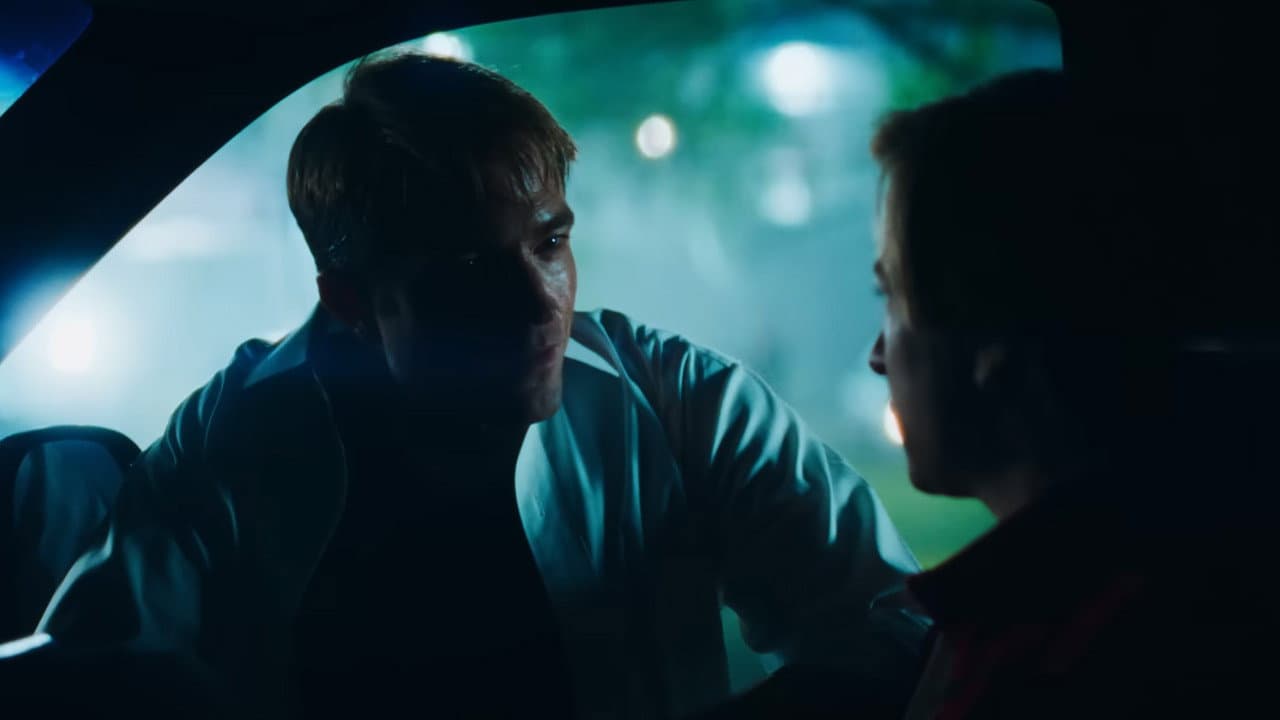
Robert Pattinson's transformation into Chris Hansen is drawing praise from critics, but the man himself isn't sold. The real Hansen, who built a career out of ambushing would-be predators on camera, has now found himself on the other side of the lens - and he doesn't much care for what he sees in "Primetime," Lance Oppenheim's dramatization of the 2006 investigation that made him a household name.
The film, released September 23, stars Pattinson as Hansen, with Merritt Wever as Andie Bender, Skyler Gisondo as Dan Plumb, and Phoebe Bridgers as Del. It holds a 6.8 rating on TMDb and runs 110 minutes. Hansen reportedly sat down with the movie and came away frustrated by how it handles the ethics of the sting operation that defined his career.
"I lived this," Hansen said of watching the dramatized version of events. "What I saw on screen wasn't the story I remember living."
That reaction may be the most on-brand thing about "Primetime." Hansen was famously a participant in the events being depicted, not merely an observer, and his discomfort raises the question of whether anyone involved in an investigation this controversial could ever be satisfied by a Hollywood retelling.
Oppenheim, best known for inventive nonfiction work, assembles a deep bench around Pattinson. Bokeem Woodbine plays Cortland Gunn, Alex Winter appears as Bill Conradt, Matthew Maher takes the role of Xavier Von Erck, and Anna Faris plays Mary Hansen. The ensemble reflects how sprawling the original saga became - what started as a local undercover operation expanded into a national controversy with real legal and personal consequences.
Hansen's public skepticism arrives at an awkward moment for the movie's awards conversation. Pattinson has spent the past several years alternating between blockbuster franchise work and deliberately oddball independent projects, and "Primetime" fits squarely in the latter category. The film asks him to play a television personality whose entire persona was built on controlled confrontation, yet Oppenheim is reportedly more interested in the machinery of the operation than in reenacting its most famous moments.
That approach may be precisely why Hansen bristles. The original broadcasts were engineered so that Hansen controlled the narrative - the camera placement, the questioning, the slow reveal of the decoy house. "Primetime" takes that control away and redistributes it to a director, a screenwriter, and an actor. For a man whose professional identity rests on being the one who asks the questions, being turned into a character is an uncomfortable demotion.
A Cultural Reckoning With the 2000s
The film lands in a broader wave of 2000s nostalgia that has grown more critical than affectionate. The mid-2000s saw reality television mutate rapidly, and the Hansen segments were among the first mainstream examples of a journalistic investigation packaged with the pacing and suspense of an entertainment product.
Oppenheim appears to be interrogating that packaging rather than celebrating it. Early viewers have noted that the movie devotes significant time to the people behind the operation - producers, analysts, and the community groups that fed tips into the pipeline. Von Erck, the founder of the activist organization that collaborated on many of the stings, is a major figure in the narrative, played by Maher.
The film's genre classification as both drama and thriller is telling. "Primetime" seems less interested in the guilt or innocence of the targets than in the production values of the pursuit itself. That framing can be read as a critique of Hansen's methods or as a defense of them, depending on the scene - an ambiguity that may explain why the real Hansen found the result unsatisfying.
The Meta Problem of Adapting a Living Subject
Hansen's complaint highlights a recurring tension in biographical filmmaking: the subject rarely recognizes the version of themselves that emerges from a screenplay. The dramatist compresses timelines, invents dialogue, and assigns motive where only behavior is documented. Hansen, whose entire career was built on documentation, is uniquely positioned to notice every departure.
Yet his objection also gives the film a strange kind of validity. If "Primetime" were a flattering hagiography, Hansen's endorsement would be worthless. His resistance suggests Oppenheim made choices that a participant wouldn't sanction - which is often a marker of a filmmaker taking the material seriously rather than simply licensing a brand.
Whether audiences agree with Hansen or with Oppenheim remains to be seen. "Primetime" is in theaters now, and the real Hansen has made clear he won't be campaigning for it.
Source: The Hollywood Reporter