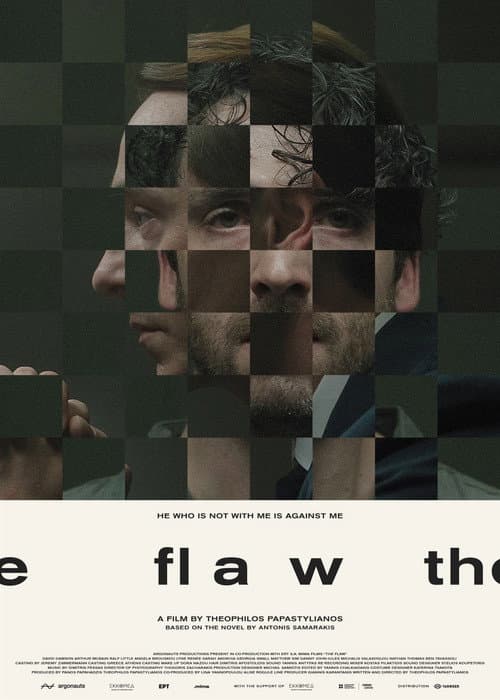
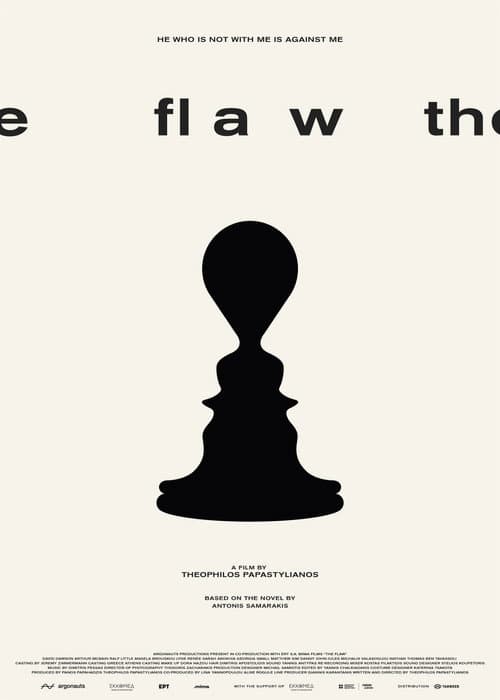
Theophilos Papastylianos's dystopian thriller "The Flaw" arrived in theaters on November 13, 2026, bringing a claustrophobic two-hander about state power and moral collapse to Hollywood audiences. Running 94 minutes, the film stars David Dawson and Arthur McBain at the center of a psychological duel staged inside a future where an unnamed Regime determines who is permitted to belong. The Line, a physical and symbolic border, separates the accepted from the excluded, and the story unfolds almost entirely in the shadow of that division.
The premise is deceptively spare. A ruthless Interrogator receives orders to carry out a flawless Plan and extract proof of a Suspect's guilt. What follows is not a conventional procedural but a game of manipulation in which the Plan advances with cold, mechanical precision. Each statement and gesture is reframed as the encounter proceeds, and the film deliberately distorts what viewers can trust. Papastylianos constructs the narrative as a puzzle whose pieces keep shifting, and the title's promise is fulfilled late: just as the logic appears sealed, a single flaw cracks the design open.
A Gun, a Line, and an Unanswerable Question
That rupture arrives with a gun in the frame. At that point the suspense pivots away from who will pull the trigger and toward a harder question - whether either man can cross the Line that has organized his entire existence. It is a fitting climax for a story that treats totalitarianism not as spectacle but as an intimate, everyday arrangement. The film's own framing captures this: "Each one of us is a regime," the project's tagline asserts, locating the machinery of control as much inside individuals as in the state that disciplines them.
The cast supporting Dawson and McBain includes Ralf Little, Angela Brouskou, Lyne Renee, Sarah Akokhia and Georgia Small. The production is an English-language Hollywood release, placing a European-inflected director at the helm of a genre piece built for English-speaking markets.
Genre Blending and a Puzzle-Box Structure
"The Flaw" is classified across four genres - thriller, drama, crime and science fiction - and its structure suggests why. The interrogation-room tension supplies the thriller engine, the moral weight of complicity carries the drama, the pursuit of a suspect's guilt supplies the crime framework, and the Regime's border politics provide the speculative architecture. Papastylianos appears less interested in world-building for its own sake than in using a bleak future as a pressure chamber for two men.
The film's emphasis on perception - reality twisted, every word recast - positions it in a lineage of paranoid political cinema where the audience's understanding is itself under interrogation. Whether the puzzle coheres on screen will be tested by viewers now that the film is in circulation.
Reception Still Forming
As of November 16, 2026, "The Flaw" holds a 0/10 rating on TMDb, a figure that reflects an absence of aggregated audience votes rather than a verdict on the film's quality. With the release only three days old, that number is expected to shift as viewers log responses. No box-office returns have been reported.
For Papastylianos, the project represents a tightly contained character study dressed in dystopian clothing - a director's exercise in sustaining dread through dialogue and implication rather than scale. For Dawson and McBain, it offers the kind of two-actor confrontation that lives or dies on performance chemistry, with the supporting ensemble orbiting a central conflict that leaves little room for escape.
"The Flaw" is now playing in theaters. Audiences drawn to political allegory wrapped in chamber-piece suspense - and to films that ask them to assemble meaning from unreliable parts - have a new puzzle to work through, one whose final piece may prove to be the flaw itself.
Source: The Hollywood Reporter