Photo: TMDb
End of Oak Street (2026) - David Robert Mitchell Film
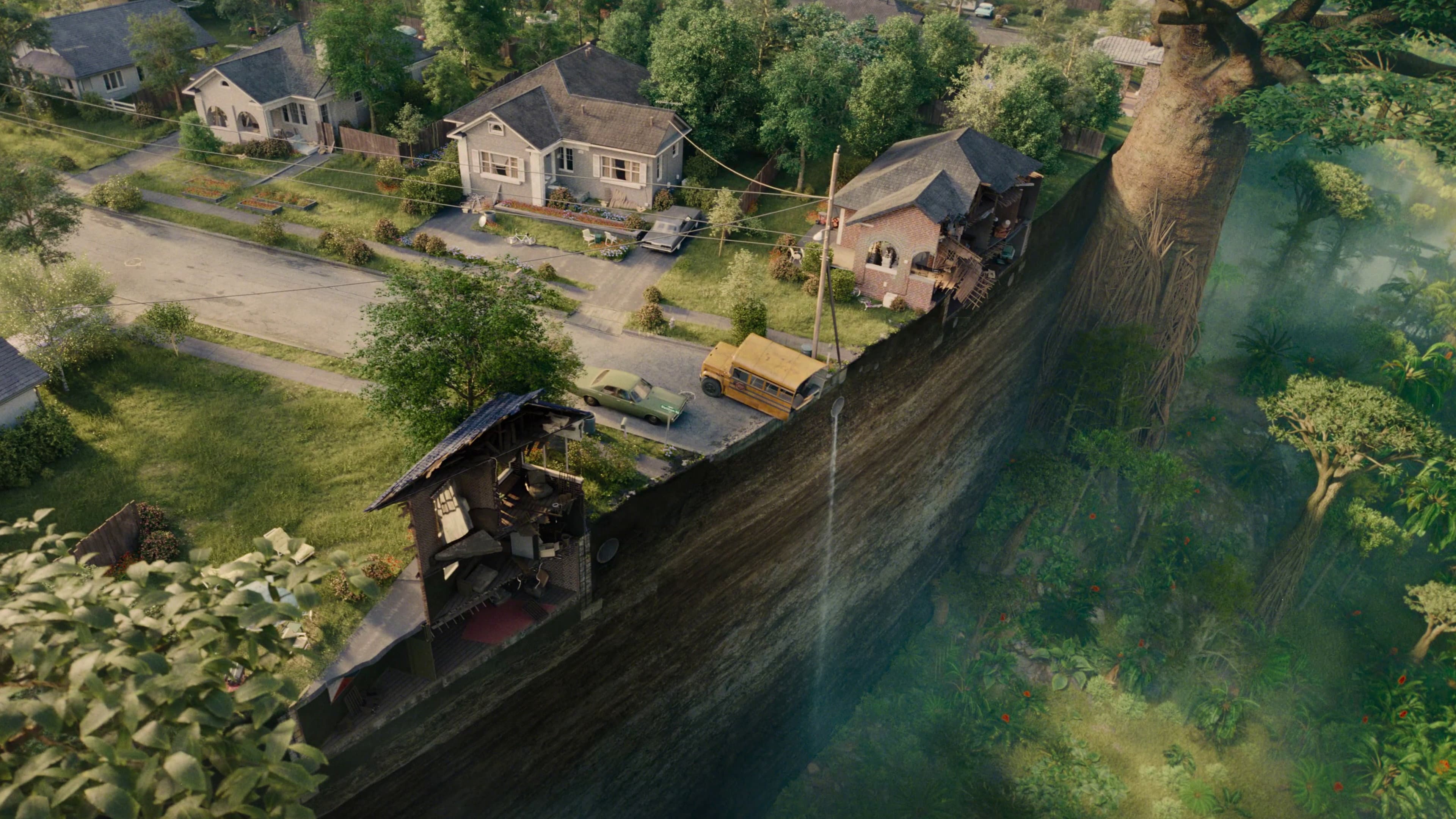
The sky above suburbia doesn’t just change in David Robert Mitchell’s taut, unnerving new thriller, End of Oak Street - it ceases to make sense. The film, which landed in theaters on August 12 after a year of feverish speculation, opens with the Platt family squabbling over a burnt casserole and a teenager’s curfew. Twenty minutes later, the streetlights flicker, a low hum vibrates through the foundation of every split-level home, and the entire cul-de-sac is gone - not destroyed, but relocated. Where Oak Street once sat, there is now only a vast, shimmering void. And where the Platts now stand, there is only somewhere else.
Mitchell, the auteur behind the dread-soaked It Follows, has never been interested in easy answers, and End of Oak Street honors that pedigree with a 100-minute puzzle box that refuses to snap shut. The film is a genre collision - part science fiction, part mystery, part paranoid thriller - but its gravitational center is the family at its heart. Anne Hathaway and Ewan McGregor anchor the picture as Denise and Greg Platt, a couple whose marriage has calcified into polite resentment. Their children, played with startling precision by Christian Convery and Maisy Stella, are less concerned with cosmic displacement than with the Wi-Fi shutting down. The first act is a masterclass in mundane panic: neighbors gather on driveways, clutching coffee mugs, arguing about whether this is a government test or a collective hallucination.
Then the sun sets, and the film’s tone shifts from anxious to genuinely sinister. The environment outside Oak Street is a fractal nightmare - a landscape of impossible geometry where the horizon folds into itself and the sky pulses with an aurora of sickly green. Mitchell renders this otherworld with practical effects and disorienting sound design, favoring creeping unease over jump scares. The neighborhood’s attempts at order collapse quickly. P.J. Byrne’s Mel Jacobs, a self-appointed block captain, begins taking roll call with the fervor of a cult leader. Jordan Alexa Davis’s Jeannette Christiansen, the teenage girl next door, starts speaking in clipped, declarative sentences that suggest she knows more than she’s letting on.
What elevates End of Oak Street beyond a typical trapped-in-a-dimension story is its refusal to explain. There are no convenient scientists, no briefing rooms, no exposition dumps. The mystery is treated with the respect of a genuine unknown, and the film’s most terrifying sequences come not from monsters but from the slow realization that the rules have changed. At one point, Greg walks to the edge of the neighborhood and looks down - and finds himself looking up at the same street from below. The logic is Escher-esque, and Mitchell shoots it with a casualness that makes it all the more chilling.
The performances are uniformly strong, but Hathaway is the revelation. Denise Platt begins as a frazzled mother prone to passive-aggressive sighs, but as the external threat grows, she hardens into a ferocious protector. A middle-act sequence where she negotiates with an unseen presence - speaking in a calm, maternal voice while her hands shake - is the film’s emotional peak. McGregor matches her with a quieter arc, playing Greg as a man whose practical skills (he knows how to fix a sump pump, not a dimensional rift) become both his weakness and his saving grace. The children, Convery and Stella, avoid the trap of being mere props; their fear feels earned, and their bond with each other becomes the film’s quiet heartbeat.
The supporting cast adds texture to the neighborhood’s micro-society. Emily Kuroda’s Mrs. Valcour, an elderly widow who tends a small garden that seems to thrive in the alien soil, delivers a monologue about her late husband that reframes the entire film’s theme of clinging to home. Bethany Anne Lind’s Mary Bagrowski, the neighborhood gossip, provides a chilling counterpoint: she’s the first to suggest that perhaps they shouldn’t try to leave. The tension between those who want to escape and those who want to adapt is where the film’s philosophical weight settles.
With a TMDb score of 7/10, End of Oak Street is not a unanimous triumph, but it is a demanding one. Some audiences may chafe at its open-ended finale, which lingers on a single, ambiguous image rather than a resolution. Yet that ambiguity feels deliberate, a refusal to reduce the unfathomable to a tidy parable. Mitchell has made a film about the terror of the unknown that also argues, quietly and persistently, that the only way through it is together. The Platt family’s survival isn’t about brute force or clever gadgets - it’s about the moment Denise reaches for Greg’s hand in the dark, and he doesn’t let go.
In a summer blockbuster season defined by spectacle and noise, End of Oak Street is a strange, patient, and deeply unsettling counter-programming. It asks not what’s out there, but what we carry inside us when the familiar is stripped away. The answer, Mitchell suggests, is both our worst fear and our only hope.