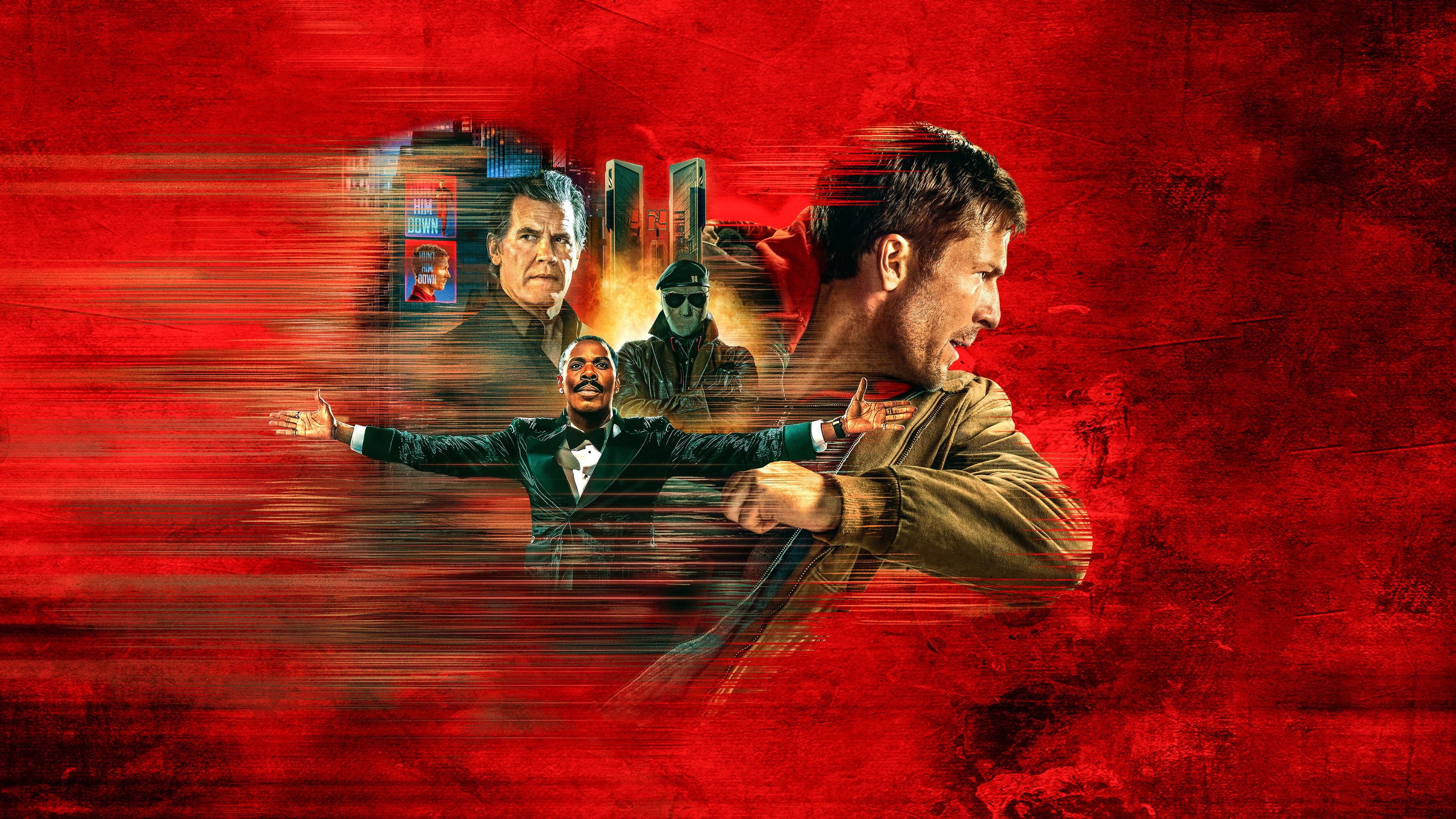
Nearly a year after it first hit theaters, Edgar Wright's adaptation of Stephen King's dystopian thriller has settled into an unusual place in the cultural memory: not quite a sleeper, not quite a phenomenon, but a film that people keep returning to, arguing about, and quoting back at each other. Released on November 11, 2025, The Running Man arrived with considerable baggage - King's novel had already been loosely translated to the screen in 1987 with Arnold Schwarzenegger, and audiences had reason to be skeptical of another pass at the material. What Wright delivered instead was something leaner and meaner, a 133-minute sprint through a near-future America that treats bloodsport as prime-time entertainment.
The premise retains King's central cruelty. Ben Richards, played by Glen Powell, is a working-class father whose daughter is gravely ill. Medical bills have stacked up past the point of solvency, and the system offers no ladder out. Enter Bobby T., the producer of The Running Man, a televised competition in which contestants are hunted across a sprawling urban landscape by professional killers. Colman Domingo plays Bobby T. with the kind of silky menace that makes charm feel like a threat - a man who believes sincerely in his product and sees desperation as raw material. Ben, out of options, signs on as a last resort. He expects to be a footnote. Instead, his refusal to perform on cue - to die with the choreographed grace the show demands - turns him into something the network never planned for.
Wright has always been a director attuned to rhythm, and The Running Man moves with the precision of a chase sequence stretched across two hours. The film's world is recognizably ours, just a few degrees off: screens everywhere, attention as currency, and a public that has learned to confuse spectacle with justice. Josh Brolin's Dan Killian, a network executive with the bearing of a man who has never been told no, presides over the machinery. Lee Pace's Evan McCone is the show's most feared Hunter, a figure whose efficiency borders on the mechanical. And William H. Macy, Michael Cera, Emilia Jones, and Daniel Ezra round out an ensemble that Wright deploys with an ear for the absurd alongside the brutal.
What distinguishes this version from its 1987 predecessor is the tonal register. Where the earlier film leaned into one-liners and muscle, Wright's take is about exhaustion - the specific fatigue of a man who keeps running because stopping means his daughter dies and the cameras keep rolling either way. Powell, who has spent the last several years oscillating between romantic leads and action roles, finds something harder here. His Ben Richards is not invincible. He is barely keeping ahead. That vulnerability is the film's engine, and it is why audiences, at 6.7 out of 10 on TMDb, have responded to it even when they find the satire heavy-handed or the third act overstuffed.
The film's most uncomfortable observation is about complicity. Ben doesn't just outrun Hunters; he becomes a ratings event. Every act of defiance is clipped, packaged, and sold back to the same public that rooted for his capture. The film understands that the audience is not outside the system - it is the system's fuel. That idea lands harder in 2026 than it might have a year ago, as the lines between reality television, political theater, and algorithmic spectacle continue to blur.
In the months since its release, The Running Man has become a reference point in conversations about how mainstream cinema handles dystopia without turning it into fantasy. Wright keeps the world close enough to touch. The arenas are recognizable streets. The killers look like people you'd pass on the way to work. The show's host smiles like someone who means it.
The film never quite resolves its tension between entertainment and indictment - it wants to be both, and sometimes that friction shows. But it has staying power, the kind that comes from a director working at full speed with a cast that understands the assignment. A year on, it remains a sharp, restless piece of Hollywood science fiction about what we watch, what we pay for, and what we become when the cameras are always on.