The opening scene of Lesbian Space Princess does not waste a single frame establishing its tone. A glittering, pastel-hued kingdom floats in a void of cosmic absurdity, and our heroine, Saira, is not training for battle or studying ancient prophecies. She is, instead, meticulously arranging a display of artisanal cheeses for a royal function, blissfully unaware that her ex-girlfriend, the swaggering bounty hunter Willow, is about to be captured by a species so aggressively mundane they are called “straight white maliens.” It is a bold, chaotic, and frequently hilarious premise - one that the film’s creative team, led by first-time feature director Emma Hough Hobbs, executes with the reckless energy of a punk zine blown up to CinemaScope proportions.
The plot is deceptively simple. Saira (voiced with a wonderfully brittle, high-strung sincerity by Shabana Azeez) is a pacifist princess who has never left her gilded, matriarchal homeworld. When Willow (Gemma Chua-Tran, all raspy bravado) is taken hostage by the maliens - a race of bland, beige-suited bureaucrats who have weaponized heteronormativity and questionable interior design - Saira must assemble a crew and venture into the galaxy's most dangerous corners. The twist? Her only allies are a sentient spaceship with a serious attitude problem (Richard Roxburgh, delivering every line with the venomous relish of a betrayed butler) and a hyper-competent, emotionally unavailable mercenary named Blade (Kween Kong, a commanding presence who steals every scene she’s in). The mission is not just to save Willow, but to prove to herself that she is more than a decorative royal.
What makes Lesbian Space Princess sing is its refusal to treat its central conceit as a mere punchline. The comedy is relentless - there is a running gag about the maliens’ inability to process any emotion beyond mild approval, and a subplot involving the queens of two rival empires (voiced by Jordan Raskopoulos and Madeleine Sami) that escalates into a diplomatic crisis over a misunderstanding about a hat - but the heart of the story is a genuinely affecting exploration of self-worth and codependency. Saira’s journey is not about learning to fight; it is about learning to ask for help, and about recognizing that love is not a rescue mission. Hobbs, who co-wrote the screenplay, has crafted a narrative where the space opera spectacle is always secondary to the awkward, messy, deeply human (or deeply sapphic) interactions between characters.
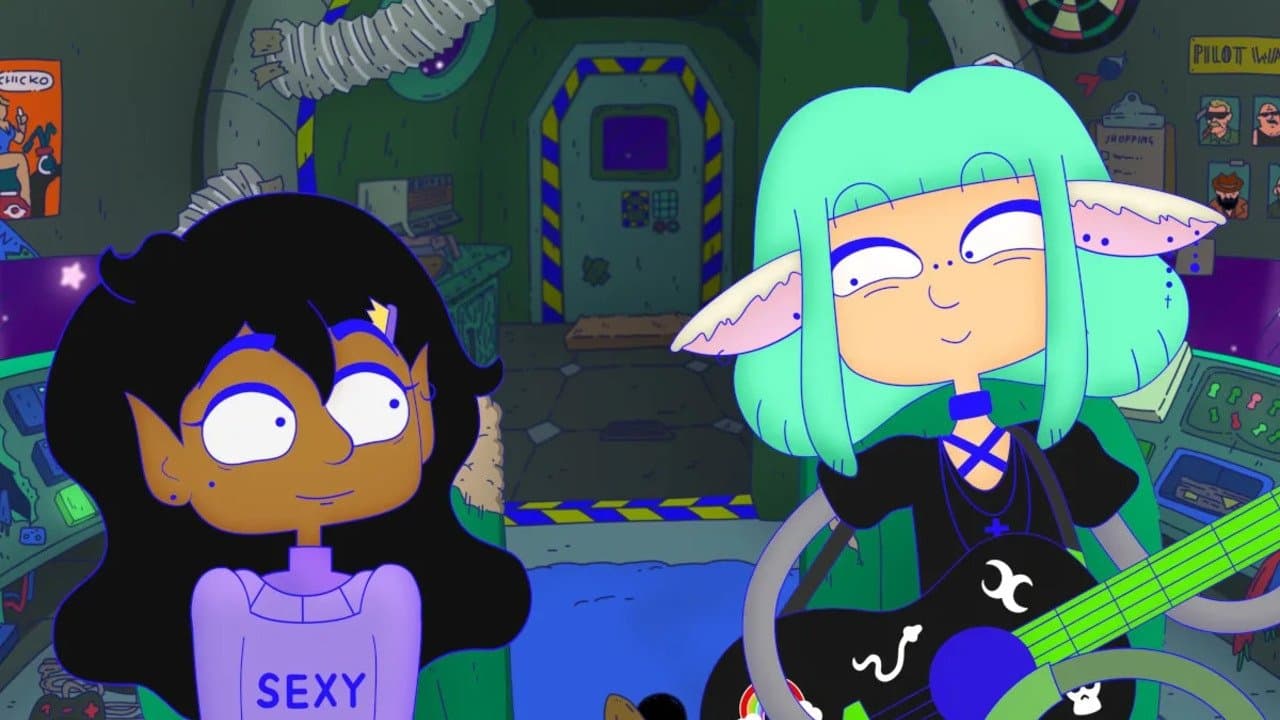
The animation itself is a riot of clashing textures and bold colors, reminiscent of late-90s Cartoon Network aesthetic crossed with a budget-conscious but inventive indie production. Backgrounds are often filled with hand-drawn doodles and kinetic typography, and the maliens’ homeworld is rendered in a suffocating palette of beige, gray, and navy, a visual shorthand for oppressive normalcy that works brilliantly against the vibrant, cluttered chaos of the princess’s own ship. It is not high-end Pixar polish, but it is never trying to be; the visual energy matches the manic, underground-comic soul of the script.
The voice cast is uniformly excellent. Roxburgh’s “Problematic Ship” is a standout, a machine that has absorbed all the toxic masculinity of its previous owners and spews it back as passive-aggressive microaggressions. His dynamic with Azeez’s Saira - who patiently, and then not-so-patiently, tries to reprogram his default settings - provides the film’s strongest comedic spine. Chua-Tran’s Willow is more of a MacGuffin than a fully realized character for much of the runtime, but her few flashback scenes with Azeez crackle with the specific tension of a breakup where neither party was entirely wrong. The film wisely lets its queer characters exist without tragic backstories or coming-out trauma; they are simply princesses, mercenaries, and queens navigating a universe that, while hostile, never questions their right to be there.
If there is a weak point, it is the pacing. The middle act sags slightly as the crew visits a series of planets that, while conceptually funny on paper, feel visually similar in execution. And the TMDb audience rating of 4/10 suggests that this is a deeply polarizing piece of work. It is easy to see why. The humor is anarchic and often juvenile, the political satire is about as subtle as a brick through a window, and the central romance lacks the emotional weight the climax demands. This is not a film that aims for broad appeal; it is actively confrontational in its queerness and its rejection of conventional heroism, and that will alienate a significant portion of viewers.
But in an era of homogenized, IP-driven blockbusters, there is something genuinely refreshing about a film this proudly weird, this unapologetically niche. Lesbian Space Princess is not a masterpiece, but it is a statement. It is a reminder that animation can be a vehicle for idiosyncratic voices, and that a story about a princess saving her ex can be just as epic as any Chris Pratt-starring franchise. It is messy, it is loud, and it is occasionally exhausting. But for those who sync with its specific frequency, it is an absurdist joyride that earns its final, surprisingly tender note. It may not be for everyone, but for the audience it is for, it is everything.