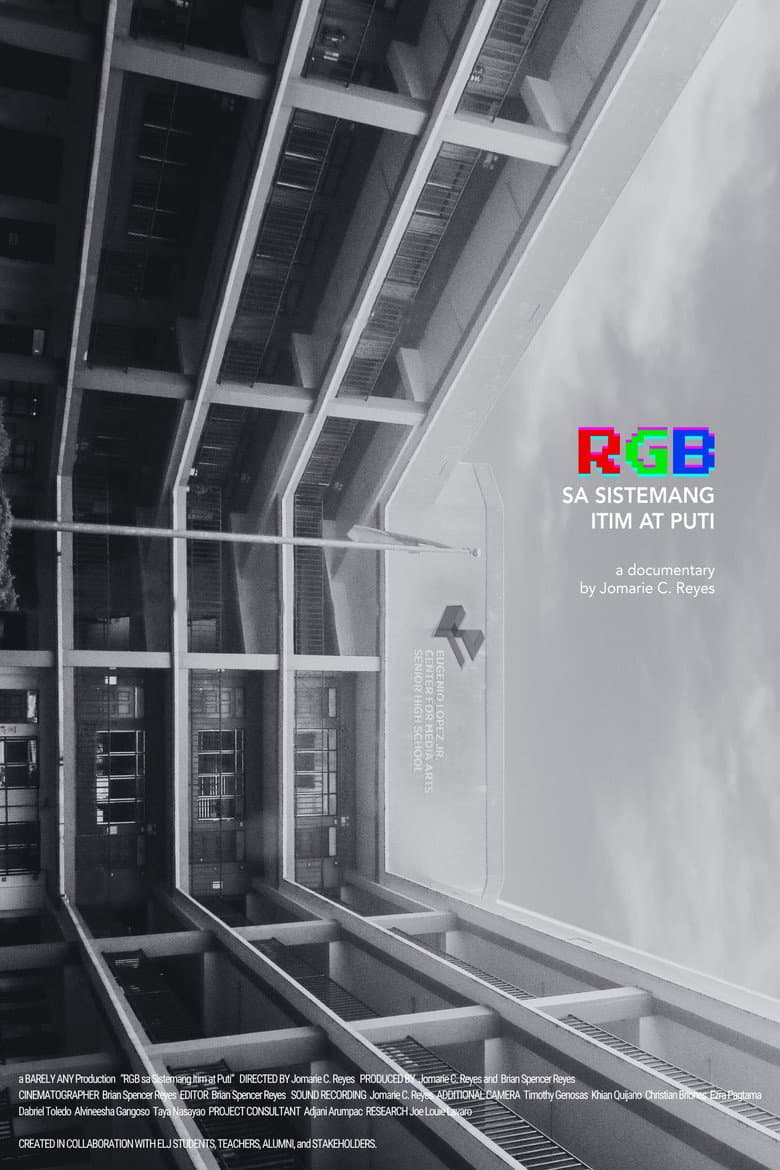
The quiet hum of a film classroom, the scratch of a pen against a final project proposal, the weight of a question no one wants to ask out loud - what happens next? That is the atmosphere captured in RGB sa Sisteman Itim at Puti, a 23-minute documentary that arrives with the precision of a time capsule and the ache of a farewell letter. Set in the Eugenio Lopez Jr. Center for Media Arts Senior High School, the film drops us into the final weeks before a national curriculum overhaul strips Media Arts from the senior high school track. There is no dramatic confrontation, no rallying cry - just the slow, methodical work of people who refuse to stop making things, even as the ground shifts beneath them.
The title, which translates roughly to RGB in a System of Black and White, is a thesis in itself. Color is the language of the medium, the very grammar of the students’ chosen craft. And yet they are being told that their future will be monochrome, dictated by a system that no longer sees their discipline as essential. The film doesn’t shout about this irony; it lets it breathe in the corridors, in the editing bays, in the tired eyes of teachers packing up equipment that may have no home next semester.
Release Date & Where to Watch
Here’s the tricky part: as of August 10, 2026, RGB sa Sisteman Itim at Puti has no confirmed release date, no distributor, and no streaming platform attached. It exists in that liminal space between festival submission and public availability - the kind of film that might premiere at a regional documentary showcase, a school-run screening, or a small independent cinema with a passion for education-focused nonfiction. Your best bet is to monitor the official channels of the Eugenio Lopez Jr. Center for Media Arts, as well as Philippine film festival circuits such as Cinemalaya or the QCinema International Film Festival, where works like this often find their first audience. Given its 23-minute runtime, it’s also a strong candidate for a short-film block or an online VOD release through a platform like Vimeo on Demand, should the filmmakers secure distribution. Keep your eyes peeled for late-2026 festival announcements; this is a film that will travel through word of mouth before it ever hits a mainstream app.
Cast & Crew
A note of transparency: the verified metadata for this project lists no director, no cast, and no crew. That’s not a mistake - it’s a reflection of how early we are in the film’s journey. What we do know is that the subjects are the students and faculty of the Eugenio Lopez Jr. Center for Media Arts Senior High School, a public institution in the Philippines dedicated to nurturing young filmmakers, animators, and visual storytellers. The film appears to be a vérité-style observational documentary, which means the “cast” is likely composed of real teenagers facing a real institutional shift - no scripted dialogue, no actors, just the unvarnished reality of a school year in crisis. The absence of credited names may also suggest a smaller, possibly student-led or faculty-driven production team, which would align with the film’s subject matter: people who make art under constraints, without waiting for permission. Expect the craft to be raw but intentional, leaning on natural light and ambient sound rather than polished interviews.
Story & What to Expect
The narrative spine is deceptively simple. The Philippine government has announced a new national curriculum, and one of its casualties is Media Arts as a standalone subject in senior high school. For the Eugenio Lopez Jr. Center, named after the late media mogul and built specifically to train the next generation of Filipino creatives, this is existential. The film’s 23 minutes capture the weeks leading up to the policy’s implementation, but don’t expect a polemic. Instead, the camera lingers on the mundane rituals of creation: a student color-grading a short film, a teacher explaining the rule of thirds for the hundredth time, a group huddle around a monitor during a rough-cut screening. There is an almost unbearable tenderness in these moments, because the audience knows - as the participants likely do - that this might be the last time these rooms hum with this particular kind of energy.
The documentary’s tension isn’t built on conflict but on anticipation. Will the students finish their capstone projects? Will the teachers find new assignments? Will the equipment be redistributed to other schools, or gather dust in a storage closet? The film doesn’t answer these questions. It doesn’t have to. The power lies in watching people continue to work, to care, to obsess over the perfect shot, even as the institutional rug is being pulled from under them. There are no talking-head experts, no statistics about arts funding, no dramatic interviews with politicians. Just the steady, unglamorous labor of people who love what they do. The title’s black-and-white system suggests a binary, a rigid structure - but the film’s RGB heart bleeds color into every frame, a quiet rebellion against being reduced to a checkbox on a curriculum form.
Why It’s Worth Watching
Because it’s not about the policy; it’s about the people the policy forgets. In an era of loud, hot-take documentaries, RGB sa Sisteman Itim at Puti is a whisper that demands you lean in. It’s a work that understands that loss isn’t always a dramatic event - sometimes it’s a Friday afternoon, the last bell ringing, and everyone pretending there will be a Monday. For educators, this film will feel like a mirror. For students, it’s a validation that their passion matters, even if the system disagrees. For anyone who has ever poured themselves into a craft that wasn’t financially rewarded, it’s a quiet anthem.
At 23 minutes, it’s also perfectly calibrated for a single sitting, but it will linger far longer. The film’s observational style trusts its subjects to carry the weight, and they do - whether it’s a teenager adjusting a tripod with trembling hands or a teacher erasing a whiteboard for the last time, knowing the next class won’t be theirs to teach. There is no villain, no easy blame. The film is too honest for that. Instead, it offers a snapshot of a specific moment in Philippine education, but its resonance is universal. This is a film about the cost of progress, the stubbornness of art, and the way young people learn to say goodbye to dreams they were just beginning to hold. That’s why it’s worth watching - because it reminds us that every curriculum, every law, every administrative decision is ultimately about human beings, and those human beings are rarely black and white. They are always, always in color.