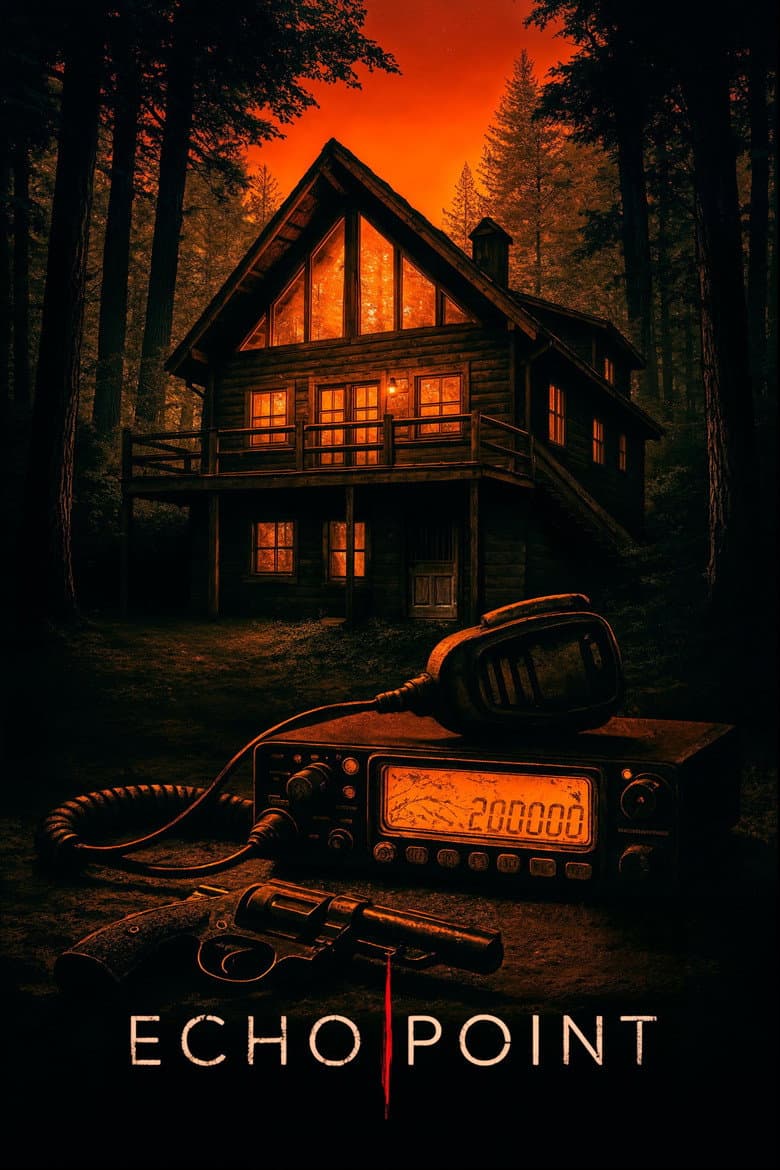
The cabin at the center of Echo Point has been sitting empty for years, and it shows. Dust settles on every surface, the kind of place that smells of old wood and abandonment. When a man inherits it from a father he barely knew, he expects little more than a weekend of sorting through junk and signing papers. What he finds instead is an old radio that won't stay quiet. It emits strange, eerie signals, voices crackling through static at odd hours. At first they could be ghosts, or interference, or his own grief playing tricks. They are none of those things. They are the victims of a killer, speaking from wherever the dead go when no one is listening, and the man who inherited the cabin soon learns he is not the first to hear them.
That premise is the engine of Evan Marcewicz's debut feature, which arrived quietly on August 28, 2026, and has spent the weeks since building an unlikely second life. Echo Point runs a mere 62 minutes, a length that makes it something of an outlier in the Hollywood thriller space, where two-hour runtimes remain the norm. Marcewicz uses nearly every one of those minutes on atmosphere, letting the dread accumulate in the corners of the frame before the story turns violent. The film's genres read like a negotiation between two impulses: Thriller, Horror, Adventure, Action. Whether it fully honors all four is a question audiences have been answering with their remote controls and their star ratings.
The cast is led by Evan Neal, with Jaime Snyder, Elizabeth Hanlon, JC Reyes, Cayden Steele, Steve Schroko, Cal Tolentino and Eugene Romanchuk rounding out an ensemble that largely trades recognizable faces for unfamiliar ones. That anonymity works in the film's favor. There is no movie-star baggage to distract from the isolation, no famous smirk to remind you that everything will be fine by the third act. Neal carries the early stretches mostly alone, a man walking through rooms that feel staged for his arrival, and the supporting players slide into the narrative as the radio begins to name them.
What has distinguished Echo Point in the weeks since release is not its marketing, which was minimal, but the gap between its critical reception and the small, stubborn audience that has adopted it. On IMDb, the film sits at a 2.4 out of 10. On TMDb, it has yet to register a score at all, holding at 0/10, a number that reflects the absence of ratings more than a consensus opinion. By conventional measures, these are disastrous figures. And yet the film keeps surfacing in conversation, passed between viewers who describe the radio sequences in hushed tones and argue about what the voices are actually saying. A 62-minute horror film with no stars and a 2.4 rating should have vanished. Echo Point has not.
Some of that resilience comes down to craft. Marcewicz, working with a clearly limited budget, understands that sound is cheaper and more effective than spectacle. The radio itself becomes the film's most expressive performer, spitting out fragments of dialogue that the protagonist must assemble into a map of his father's misdeeds. The cabin's isolation does the rest. Every creak of the floorboards, every gust against the windows, every moment the signal drops out and the silence rushes back in reinforces the same idea: the dead have nowhere else to go, and neither does he.
The film's admirers argue that the low rating reflects a mismatch of expectation rather than quality. Viewers who arrived expecting wall-to-wall action, as the genre tags might suggest, found instead a slow, mournful chamber piece about inheritance and complicity. Those who stayed discovered a story less interested in the killer than in the people he left behind, still transmitting, still waiting for someone to pick up the receiver. Whether that is enough to sustain the film's growing reputation is a question only time will answer. For now, Echo Point sits where it has sat since August: a strange signal in a crowded landscape, audible to anyone willing to tune in.