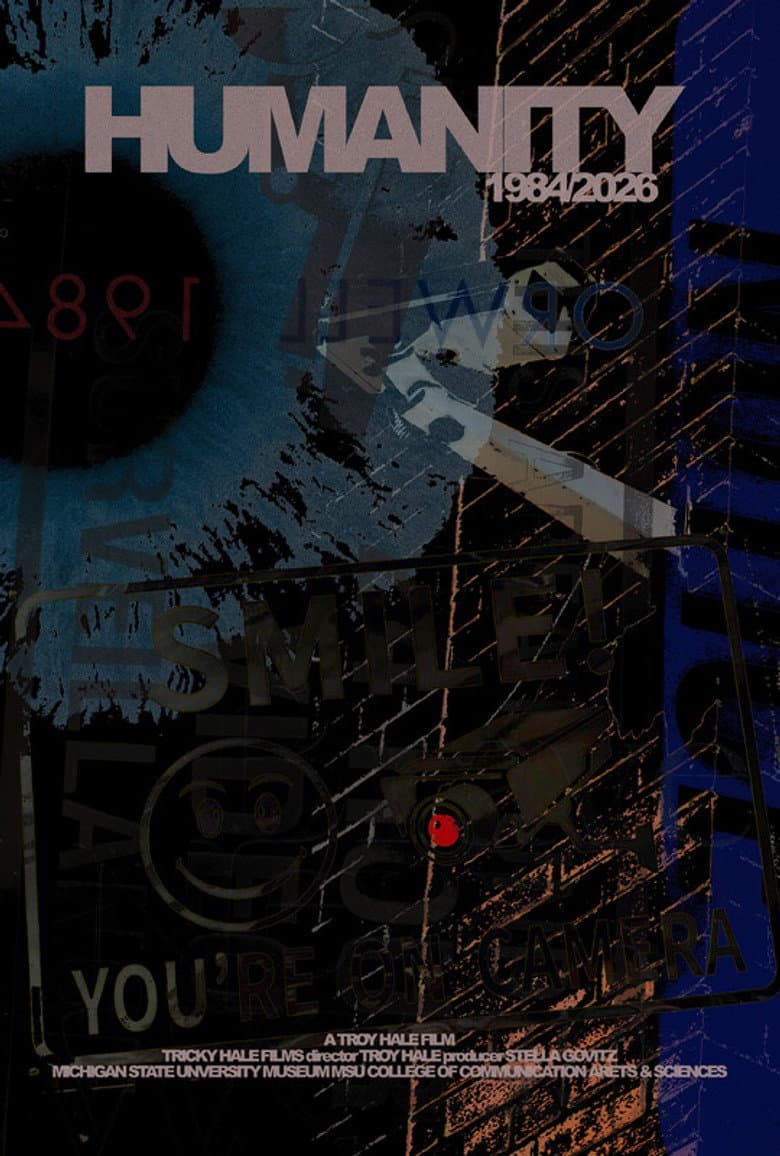
The billionth surveillance camera went up five years ago. One lens for every eight people on the planet. Stack facial recognition and predictive AI on top of that hardware, and the math stops being abstract. That is the premise Troy Hale works through in Humanity (1984/2026), a four-minute film landing today, September 12, 2026, and it arrives while the argument over FLOCK cameras is still loud enough to hear from the sidewalk.
Release Date & Where to Watch
Humanity (1984/2026) releases on September 12, 2026. That is the whole of what has been confirmed about distribution so far - no streaming platform, no theater chain, no festival window attached to the announcement. For a four-minute film, that is less unusual than it sounds. Short-form work often surfaces first through festival circuits, director retrospectives or platform premieres before settling into a permanent home, and Hale's project may follow the same path. Keep an eye on the film's official channels for the rollout. What we know for certain: it is out today, and it is short enough to watch twice before you finish your coffee.
Cast & Crew
The cast list has not been published. No names, no ensemble, nothing to speculate on - and given the film's four-minute runtime, that silence may be intentional rather than a gap in reporting. The project belongs to Troy Hale in the director's chair, working in English under the Hollywood banner. A compact crew fits the format: an idea this concentrated does not need a sprawling production to land. Hale's authorship is the throughline here, and the film's identity rests on his direction rather than on star wattage.
Story & What to Expect
The film's official overview lays out its thesis without blinking: in a surveillance state, you are always being watched. The billionth camera was installed in 2021. One camera per eight human beings. Add facial recognition and AI, and the claim escalates - we can predict all human movements. Then the question, dropped like a stone: are we really free?
The title deserves a moment. Humanity (1984/2026) carries two years inside it, and the pairing reads as deliberate. 1984 summons Orwell's telescreen, the novel's vision of a state that watches without pause. 2026 is now, the year the film releases, the year the FLOCK camera debate has spilled from city council meetings into everyday conversation. The parenthetical refuses to let the two sit apart. What Orwell rendered as dystopian fiction in 1984, the title implies, has a 2026 counterpart built from procurement contracts and license plate readers.
At four minutes, expect compression rather than exposition. There is no room for a slow build, so the film likely opens already inside its argument - camera imagery, recognition software, the machinery of tracking rendered as montage, a voice or a text overlay driving the question forward. That the overview name-checks FLOCK specifically tells you the film is not chasing a hypothetical. It is talking about equipment already mounted on poles in real neighborhoods, already generating data, already contested in public hearings. A viewer will not get a character arc across four minutes. They will get a position, stated with whatever force Hale can muster, and then the credits.
One thing the metadata is honest about: the genres are listed as unknown. Whether this plays as documentary essay, experimental short or something hybridized between them is genuinely unresolved. Treat that as part of the intrigue rather than a flaw in the listing.
Why It's Worth Watching
The timing makes the case on its own. A film about mass surveillance releasing in the middle of a national argument over mass surveillance is not coincidence - it is placement. The FLOCK outrage referenced in the overview gives the project a live wire to grab, and four minutes is a frictionless commitment. You are not blocking out an evening; you are giving the film the same attention you would give a trailer.
The scale of the numbers does the rest. One billion cameras. One per eight people. Facial recognition layered over the top. Predictive AI layered over that. The overview ends with a question rather than a conclusion, and questions that size tend to linger well past a four-minute runtime. The film also carries a TMDb rating of 0/10, but with zero votes accounted for, that figure reflects nothing but an empty slot - no audience has weighed in yet.
What remains is a short, pointed piece from a director working in the Hollywood system and releasing it into a year where its subject matter sits squarely in the news cycle. If you have followed the FLOCK debates, if you have wondered who is watching the watchers, Humanity (1984/2026) is asking the same thing. Four minutes. Today. See it, and then decide whether the question deserves a longer answer than the film provides.