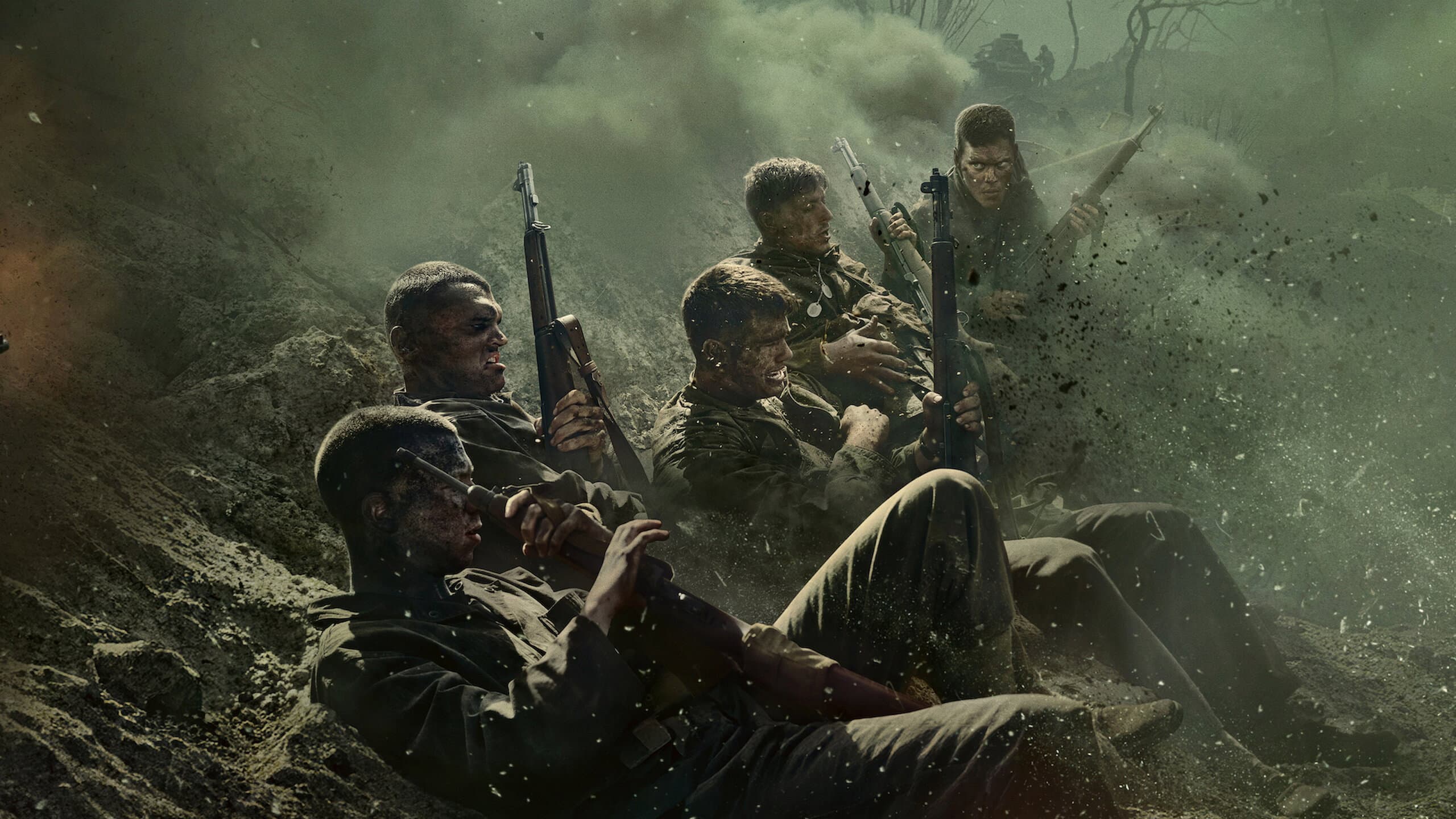
The Marines who gathered on Guadalcanal in the winter of 1944 had not come for a football game. They were preparing for one of the bloodiest campaigns of the Pacific War, and the officers of the 4th and 29th Marine Regiments needed a way to keep thousands of young men from drowning in dread. What they got was a scrimmage played in the mud before an audience of troops, a brief, strange spectacle that history remembers as the Mosquito Bowl. Peter Berg's new film of the same name, in theaters since October 29, takes that footnote and turns it into something far larger: a portrait of four college football stars whose paths from campus to combat form the spine of a war drama that is as much about friendship as it is about fire.
Nicholas Galitzine leads the ensemble as John McLaughry, a Brown University standout whose decision to enlist after Pearl Harbor sets the film in motion. He is joined by Bill Skarsgård as Bob Bauman, Ray Nicholson as Tony Butkovich, and Tom Francis as Dave Schreiner, each of them gifted athletes who traded a season on the gridiron for a rifle and a helmet. Berg, working from a screenplay that draws on the real histories of these men, refuses to treat their athletic pasts as mere color. Football, in this film, is a language the characters use to make sense of everything else. The discipline of practice, the trust that comes from knowing the man beside you will hold his ground, the way a huddle can feel like a shelter against the world: all of it returns in the jungles of the South Pacific, refitted for a deadlier contest.
The director's instincts for physical scale are well documented, and he puts them to use here without letting spectacle swallow the people at the center. The training sequences have a documentary grain, all sweat and shouting and the dull thud of pads. The combat passages are harrowing but never gratuitous, shot with an intimacy that keeps the audience close to the men rather than above them. What lingers, though, are the quieter moments: a letter read aloud by lamplight, a card game interrupted by news from home, a conversation between McLaughry and Jane, played by Ella Newton, that carries the weight of a life that might not be waiting for him.
The supporting cast fills out the regiment with care. Brent Comer appears as George Murphy, Dominic Bogart as Wilkes, and Jack Ingram as Wilson, each contributing to the texture of a unit that feels lived-in rather than assembled. Skarsgård brings a coiled intensity to Bauman, while Nicholson's Butkovich supplies a warmth that makes the film's later turns land harder. Francis, as Schreiner, gets some of the script's most affecting passages, and Galitzine anchors the ensemble with a performance that mixes youthful bravado with a growing awareness of what the war will cost.
At 129 minutes, The Mosquito Bowl allows itself room to breathe. The film understands that brotherhood is built in the mundane hours between battles, and it earns its emotional payoffs by investing in those hours. Berg and his editors keep the pacing deliberate, moving between the football fields of the home front and the foxholes of the Pacific with a rhythm that mirrors memory more than chronology. The result is a war drama that feels less like a reenactment than a reckoning.
The film arrives at a moment when audiences have shown renewed appetite for stories about ordinary people caught in extraordinary history, and its themes of sacrifice and camaraderie are likely to resonate well beyond the holiday season. It does not flinch from the cost of war, but neither does it wallow. Instead, it holds two ideas in tension: that these men were remarkable for what they achieved on the field, and that they were ordinary in the ways that mattered most, frightened, loyal, and desperate to come home.
With a 7.2 rating on TMDb and a release timed to the fall prestige corridor, The Mosquito Bowl is positioned as one of the season's more substantial offerings. What it leaves behind is not a highlight reel of heroics but a memory of four friends who found each other in the worst of circumstances and made something worth remembering. In Berg's hands, that muddy scrimmage becomes a quiet act of defiance and a testament to the men who played it.