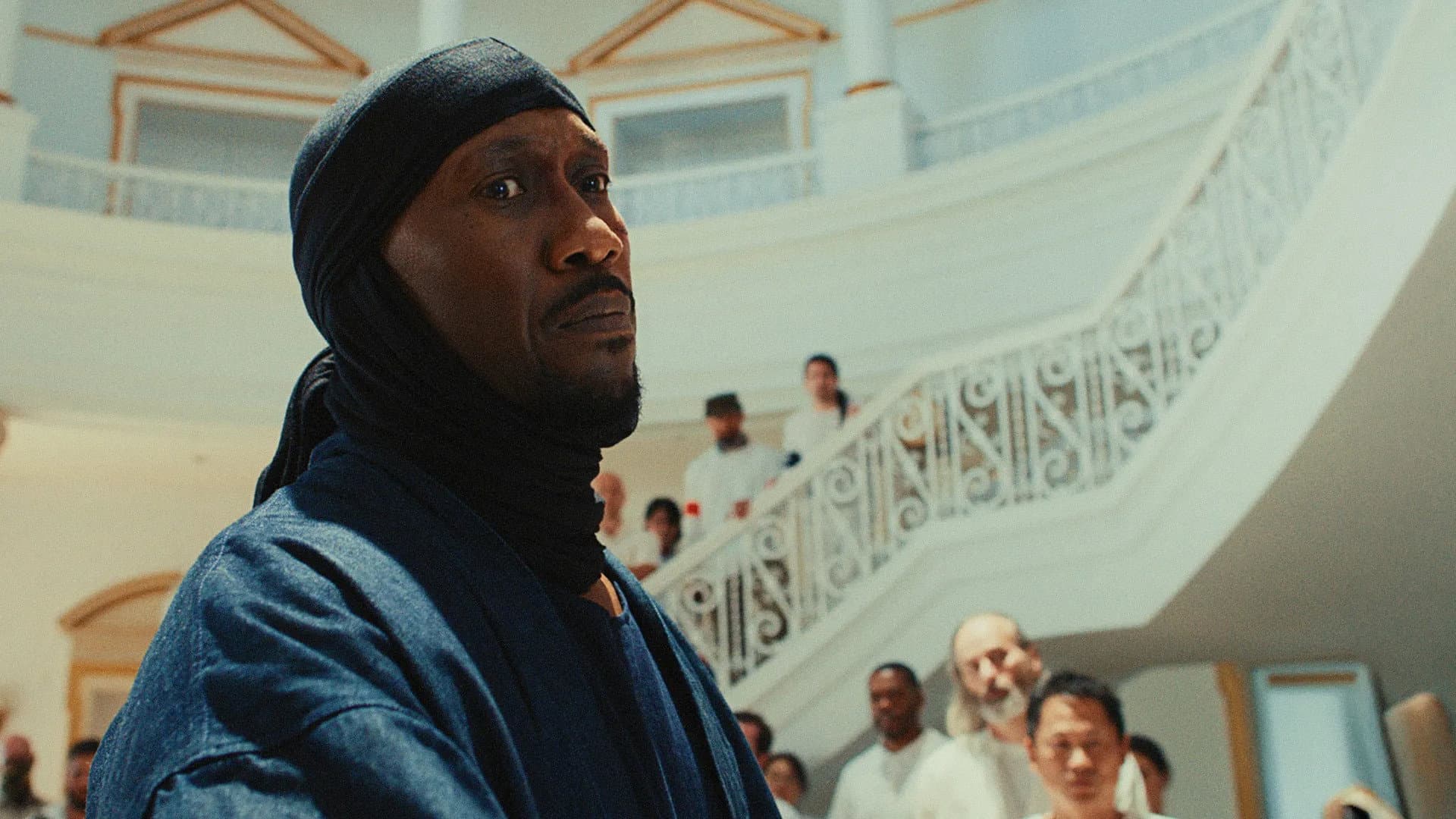
The first sound in “Your Mother Your Mother Your Mother” is not a gunshot or a squealing tire. It is the soft, rhythmic cadence of a man praying. Latif, played with a quiet, terrifying gravity by Mahershala Ali, is on his knees on a Houston apartment floor, and the camera holds on him long enough that the prayer begins to feel like a negotiation. He is asking for protection. He is also, by the time the film cuts to the trunk of his car, on his way to kill someone.
That tension - between devotion and violence, between the father and the fixer - is the engine of director Bassam Tariq’s new feature, which opened in theaters on September 25 to a 7.6 rating on TMDb and a growing reputation as one of the fall’s most morally complicated thrillers. The film runs 112 minutes and is entirely in English, a Hollywood production that folds the crime drama, the family saga and the spiritual crisis into a single, restless chase across a city that never quite lets its characters breathe.
The logline is deceptively simple. Latif is a devoutly religious hitman. He has a wife, children, a routine. Then his wife dies, and the routine collapses. What follows is a desperate journey across Houston to protect his kids from the forces closing in around him - and from the beliefs threatening to unravel within him. Tariq, working from a script that treats theology as a source of suspense rather than a lecture, keeps the camera close and the geography disorienting. Houston becomes a maze of freeway overpasses, strip-mall mosques and church basements, a sprawl that mirrors Latif’s increasingly frantic state of mind.
Ali’s performance is the anchor. He plays Latif not as a cold professional but as a man doing careful mental arithmetic at all times - how much he can afford to tell his children, how much he can afford to feel, how many minutes he has before the next call. It is a role that could easily become a collection of tics, but Ali keeps it internal, letting the character’s faith show in small, physical ways: the way he washes before prayer even in a gas-station restroom, the way his hands hesitate before he does what he has been paid to do.
Around him, Tariq has assembled an ensemble of characters who each apply pressure to Latif’s crumbling world. John Cho appears as Pastor Kwan, a neighborhood clergyman whose kindness is not entirely free of curiosity about the man he suspects Latif to be. Giancarlo Esposito, reliably precise, plays Abdul Malik, a figure from Latif’s orbit whose authority is both paternal and threatening. Abubakr Ali brings a jittery energy as Hatty, while Laith Nakli’s Mike Mahmoudi supplies some of the film’s few moments of uneasy levity. Adia, Jahleel Kamara and Tiffany Boone round out a cast that never feels like set dressing.
What distinguishes the film from a standard crime thriller is its refusal to separate the domestic from the dangerous. The children are not hostages to be rescued in the third act; they are present throughout, witnesses to the slow erosion of their father’s certainty. Tariq shoots the family’s home like a war room and the city like a series of thresholds. In one standout sequence, Latif drives his daughters to school while taking a call that will determine whether a man lives or dies, and the film’s sound design - the turn signal, the radio, the child in the back seat asking about dinner - does more work than any shootout could.
That is not to say the action is soft. When the violence arrives, it is sudden and unglamorous, over in seconds, leaving the characters to deal with the aftermath rather than the spectacle. The film’s crime-genre bones are real, and fans of the form will find the pacing and the set pieces satisfying. But Tariq is after something more uncomfortable: a portrait of a man who has organized his life around rules and discovers, too late, that the rules do not cover grief.
“Your Mother Your Mother Your Mother” is not a film that offers easy comfort. It asks whether faith can survive the things a man does to protect his family, and it declines to answer on the audience’s behalf. What it offers instead is a performance of rare conviction, a director in full control of his material, and a final image - Latif, alone, in the quiet after the noise - that lingers long after the credits roll. In a season crowded with sequels and spectacle, that is its own kind of rare thing.